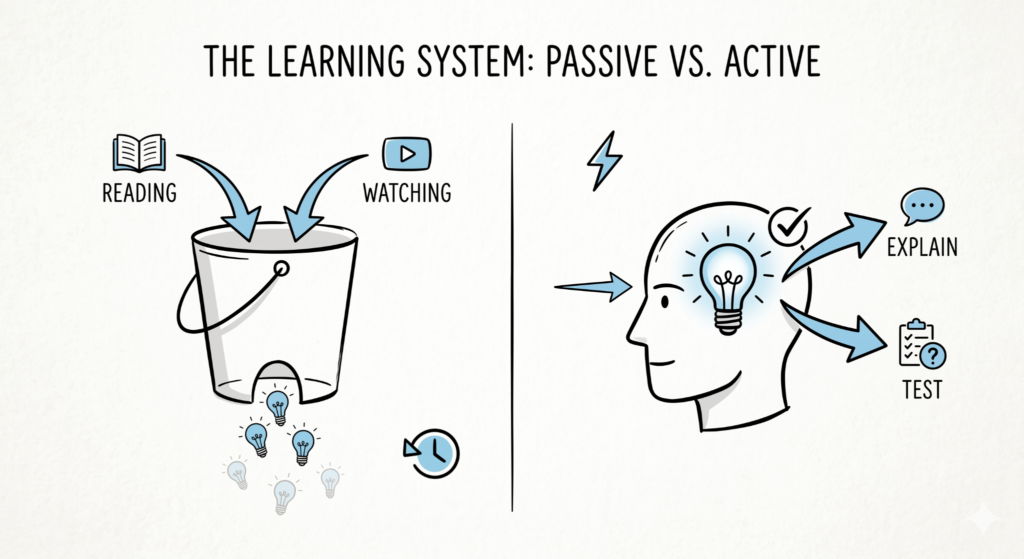
Most people approach learning like they’re trying to fill a bucket with a hole in the bottom. They spend hours highlighting textbooks, re-reading notes, and watching tutorials, only to realize two days later that the information has evaporated.
This isn’t a “memory problem” – it’s a system problem.
To learn anything at lightning speed, you have to stop acting like a consumer and start acting like a producer. Real learning doesn’t happen when you put information into your brain; it happens when you try to get it out. This guide is designed to move you from passive observation to aggressive mastery by leveraging the way your biology actually functions.
The Illusion of Competence
The biggest trap for beginners is the Illusion of Competence. When you read a chapter twice, the text becomes familiar. Your brain recognizes the words and whispers, “I know this.”
Spoiler alert: It doesn’t.
Recognition is not the same as retrieval.
- Recognition: I’ve seen this before. (Passive/Weak)
- Retrieval: I can explain this from scratch. (Active/Strong)
To bypass this trap, we use Metacognition – the art of thinking about your own thinking. Before you dive into the “what,” you must master the “how.”
Passive vs. Active: The Performance Gap
| Feature | The Passive Trap (Slow) | The Active Edge (Fast) |
| Primary Activity | Re-reading and Highlighting | Self-Testing and Explaining |
| Effort Level | Low (Feels easy, yields little) | High (Feels hard, yields mastery) |
| Neural Impact | Weak pathways; easily forgotten | Deep “ruts” in the brain; long-term |
| Feedback | Delayed (Realized during the test) | Instant (Realized during the practice) |
By the end of this guide, you won’t just be “studying” harder – you’ll be out-thinking the learning process itself.
Let’s rebuild your brain’s operating system.
Phase 1: The Pre-Game – Priming Your Brain for Velocity
Most learners treat a new subject like a dense forest they have to hack through with a dull machete. They dive into page one, word by word, hoping that if they struggle long enough, they’ll eventually see the light.
Senior learners do the opposite. They perform Intellectual Reconnaissance.
Before you commit a single fact to memory, you must use Metacognition – the process of “thinking about your thinking.”
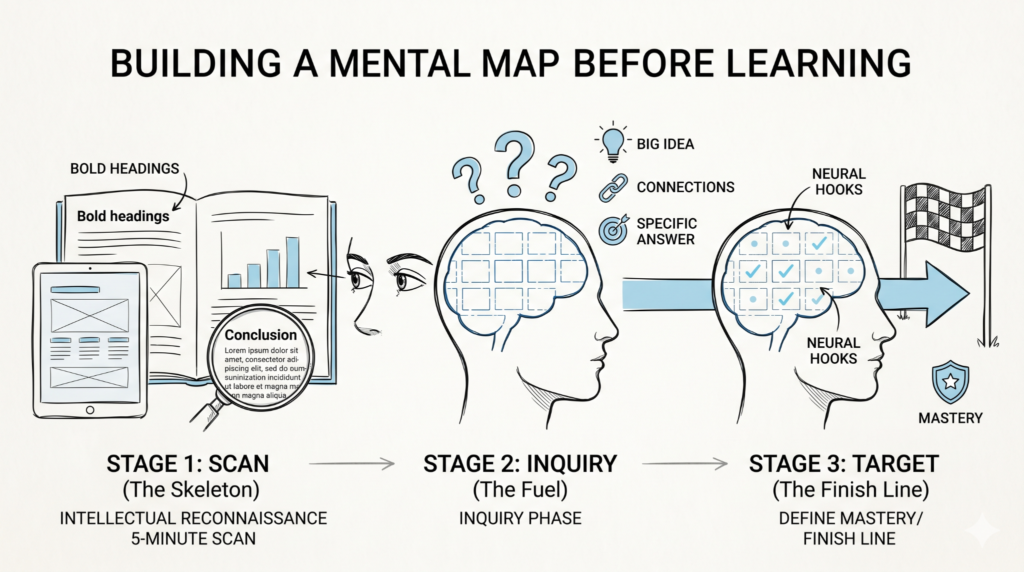
Phase 1 is about building a mental map so your brain knows exactly where to store new information when it arrives.
1. The 5-Minute Scan (Priming)
Priming is the act of exposing your brain to the “skeleton” of a topic before you look at the “flesh.” When you scan headings, bolded terms, and diagrams, you are creating neural hooks. Without these hooks, new information has nothing to hang on to and simply falls out of your memory.
How to Prime?
- Flip the Pages: Don’t read. Just look. Spend 30 seconds on each page of a chapter.
- Focus on Visuals: Study the charts, captions, and infographics. These are often the “Summary” of the most important data.
- The Chapter Summary: Read the conclusion first. If you know where the story ends, the journey there makes much more sense.
2. The Inquiry Phase: Curiosity as a Catalyst
Your brain is a filter designed to ignore boring information. To “unlock” the filter, you have to convince your brain that the information is a solution to a problem.
Before you start, ask yourself three questions:
- What is the ‘Big Idea’ here? (The 30,000-foot view)
- What do I already know that is similar to this? (Connecting to existing knowledge)
- What is the one question I want this section to answer?
3. Defining the “Finish Line”
“Learning Python” or “Understanding History” are too vague. Vague goals lead to vague results. You need to define what Mastery looks like for this specific session.
| Instead of… | Try this (The Finish Line) |
| I want to study Economics. | I want to be able to explain the Law of Supply and Demand to a friend. |
| I’m going to practice guitar. | I will play the C-Major scale at 100 BPM without a mistake. |
| I need to read this report. | I will identify the three biggest risks mentioned in this executive summary. |
The brain is a heat-seeking missile for answers. If you don’t give it a question to chase, it will go to sleep. Priming provides the target; Inquiry provides the fuel.
Phase 1 Checklist:
- Scan: Have I looked at every heading and image in this section?
- Hook: Have I found one thing I already know that relates to this?
- Target: Have I written down exactly what I want to be able to do once I’m finished?
By spending just 10 minutes on Phase 1, you reduce Cognitive Load – the mental strain of trying to figure out “what is going on” – allowing you to focus 100% of your energy on actually absorbing the material.
Phase 2: Deep Understanding – The Feynman Technique
Now that you’ve primed your brain and set your target, it’s time to actually digest the information. Most people fail here because they mistake familiarity for mastery. They read a paragraph, it makes sense, and they move on. If you can’t explain it simply, you don’t understand it.
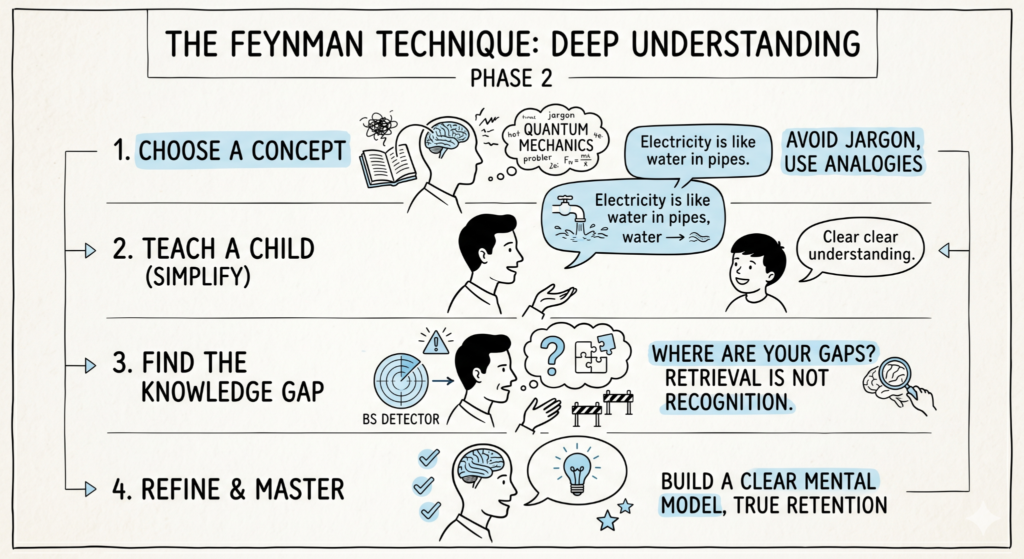
In Phase 2, you’ll use the Feynman Technique, named after Nobel physicist Richard Feynman. It is the ultimate “BS detector” for your own brain. It forces you to strip away jargon and get to the core of a concept.
The Four Steps to Mastery.
Step 1: Choose Your Target
Take a blank sheet of paper. Write the name of the concept you’re learning at the top. This is the “mental folder” you are about to fill.
Step 2: Explain it to a 12-Year-Old
Write out an explanation of the concept as if you were teaching it to a child.
- No Jargon: You cannot use big words or technical terms. If you have to use a technical term, you must explain that term simply first.
- Simple Language: Use analogies. (e.g., “Electricity is like water flowing through a pipe.”)
Step 3: Identify the “Gaps”
This is where the magic happens. While writing your explanation, you will inevitably hit a wall where you think, “Wait, how does that part work again?” These are your Knowledge Gaps. Go back to your source material (the book, the video, the notes) and specifically study only those missing pieces until you can explain them simply.
Step 4: Review and Refine
Now, take your fragmented notes and weave them into a clear, cohesive narrative. Read it out loud. If it sounds clunky or confusing, simplify it further. Your goal is a “polished” explanation that makes sense to anyone.
The Name vs. The Thing
Feynman famously noted that you can know the name of a bird in every language in the world, but you will still know absolutely nothing about the bird itself.
| Knowing the Name (Surface) | Knowing the Thing (Deep) |
| That is the Law of Inertia. | Objects keep doing what they’re doing unless something pushes them. |
| It’s a Photosynthetic process. | Plants turn sunlight into food using a chemical factory in their leaves. |
| The ROI is 15%. | For every dollar we spent, we made fifteen cents in profit. |
Why This Works (The “Hard” Truth)
This technique is exhausting. It requires significantly more effort than just reading. But that cognitive strain is the sound of your brain building new synapses. By forcing yourself to simplify, you are building a Mental Model that will stay with you forever, rather than a string of words you’ll forget by Tuesday.
Note: Knowledge Gaps are not failures; they are GPS coordinates for your next five minutes of study. Don’t fear the ‘I don’t know’ – chase it.”
Phase 2 Practice
Before moving to Phase 3, take the one thing you’ve spent the most time “learning” this week and try to explain it in three sentences to someone who has never heard of it. If you stumble, you know exactly what to study next.
Phase 3: Managing the Load – Chunking & Interleaving
Even the most brilliant brain has a “memory ceiling.” If you try to jam too much information into your head at once, your Cognitive Load redlines, and your brain simply stops recording. This is why you can read a page five times and still not “see” the words.
Phase 3 is about organization and strategy. We are going to take that raw understanding from Phase 2 and organize it so your brain can handle it without crashing.
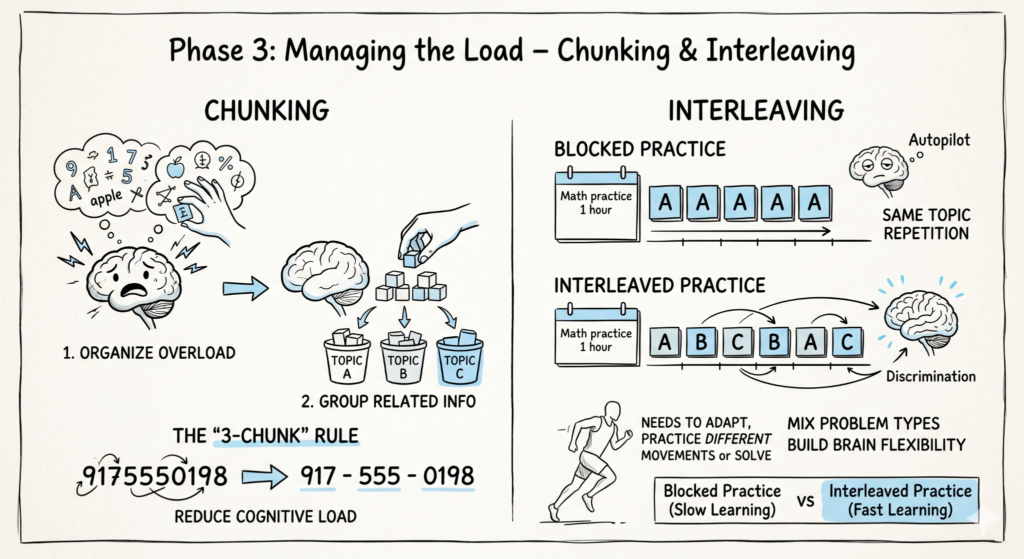
1. Chunking: The Art of “Meaningful Bites”
Your working memory can only hold about 4 to 7 “bits” of information at a time. If those bits are random, you’ll fail. If those bits are chunks, you can store massive amounts of data.
The Phone Number Trick:
- Try to memorize this: 9175550198. Hard, right?
- Now try this: 917 – 555 – 0198.
By grouping the numbers, you turned ten random bits into three meaningful chunks.
How to Chunk in Learning?
- Identify Patterns: Don’t memorize 50 individual Spanish words; group them by Food, Travel, or Emotions.
- The Big Picture First: Always relate a small detail back to the “Big Idea” you found in Phase 1. A detail without a category is just mental noise.
2. Interleaving: The “Variety” Principle
Most people use Blocked Practice, they study Topic A for two hours, then Topic B for two hours. Research shows this is actually slower for long-term mastery.
Interleaving is the practice of mixing related topics or problem types within a single session.
- Blocked: AAA — BBB — CCC (Feels easy, but creates “robot” learning)
- Interleaved: ABC — BCA — CAB (Feels harder, but creates “athlete” learning)
| Feature | Blocked Practice (Slow) | Interleaved Practice (Fast) |
| Example | Practicing 50 additional problems. | Mixing addition, subtraction, and word problems. |
| Brain Effort | Low (The brain goes on “autopilot”). | High (The brain must “choose” the right tool). |
| Skill Transfer | Poor (You struggle in “real world” chaos). | Excellent (You learn when to use a skill). |
3. The “3-Chunk” Rule
When starting a new session, never try to master more than three core concepts at once.
- Learn Concept A.
- Learn Concept B.
- Practice A and B together.
- Add Concept C.
- Mix A, B, and C.
By mixing them, you force your brain to distinguish between them. This prevents the “I knew it at home but forgot it during the test” syndrome.
Confusion is the sweat of the brain. When you interleave topics, it feels messy and frustrating. That frustration is the feeling of your brain actually working to build a permanent structure.
If it feels too easy, you probably aren’t learning anything.
Phase 3 Checklist:
- Break it down: Have I grouped individual facts into 3-5 major categories?
- Mix it up: Am I switching between different types of problems instead of doing the same one repeatedly?
- Limit the load: Am I focusing on a maximum of 3 “Big Ideas” in this session?
We’ve understood it (Phase 2) and organized it (Phase 3). Now, how do we make sure it stays in your head forever?
Phase 4: Permanent Memory – The Science of “Locked-In” Learning
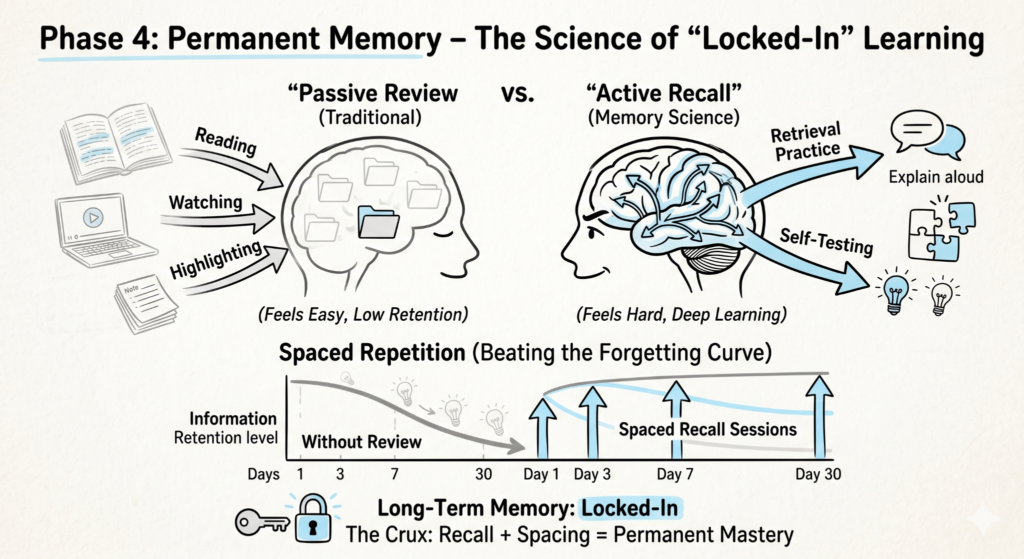
You’ve understood the material and organized it into chunks. Now comes the most common point of failure: The Forgetting Curve. Research by Hermann Ebbinghaus shows that within 24 hours, the human brain forgets up to 70% of what it just learned unless it is actively challenged to remember.
Phase 4 is about moving information from your fragile short-term memory into your indestructible long-term “hard drive.” To do this, we use the two most powerful tools in cognitive science: Active Recall and Spaced Repetition.
1. Active Recall: The “Search and Rescue” Mission
Most people “review” by re-reading their notes. This is a waste of time. Re-reading is input; remembering is output.
Active Recall is the act of closing the book and forcing your brain to retrieve the information from scratch. Every time you struggle to remember something, you are physically strengthening the neural pathway to that information.
How to do it:
- The “Blank Sheet” Method: After a study session, take a blank piece of paper and write down everything you remember without looking at your notes.
- Flashcards (The Right Way): Use apps like Anki or Quizlet. Don’t just look at the answer – say it out loud before you flip the card.
- Practice Tests: Treat every practice question like a real exam. No peeking.
2. Spaced Repetition: Beating the Forgetting Curve
The best time to review something is right when you are about to forget it. If you review a fact every day for a week, you’re wasting effort. If you review it at increasing intervals, you “hack” your brain into keeping it forever.
The Spacing Schedule (General Rule):
- 1st Review: 24 hours after learning.
- 2nd Review: 3 days later.
- 3rd Review: 1 week later.
- 4th Review: 1 month later.
| Method | Effort | Long-Term Retention |
| Cramming (All night before) | High | Low (Gone in 48 hours) |
| Re-reading | Low | Low (Illusion of knowledge) |
| Spaced Recall | Moderate | High (Permanent mastery) |
3. The “Struggle” is the Signal
Most students quit when they can’t remember a fact. They think, “I’m just not good at this.” Actually, the moment you are struggling to remember is the exact moment your brain is growing. This is called Desirable Difficulty. If it’s easy to remember, you aren’t learning. If you have to “reach” for the answer, the connection becomes permanent.
Stop trying to keep the info in your head. Try to pull it out. The ‘reach’ is where the magic happens. Think of your brain like a muscle – if the weight is too light, the muscle doesn’t grow. Active Recall is the heavy lifting.
Phase 4 Checklist:
- Close the Book: Am I testing myself instead of just reading?
- The Gap Test: Did I identify the things I couldn’t recall and re-study them?
- Schedule the Next Hit: Did I set a reminder to review this topic in 3 days?
We have the understanding, the structure, and the memory. Now, we need speed.
Phase 5: Strategic Efficiency – The 80/20 Rule (Pareto Principle)
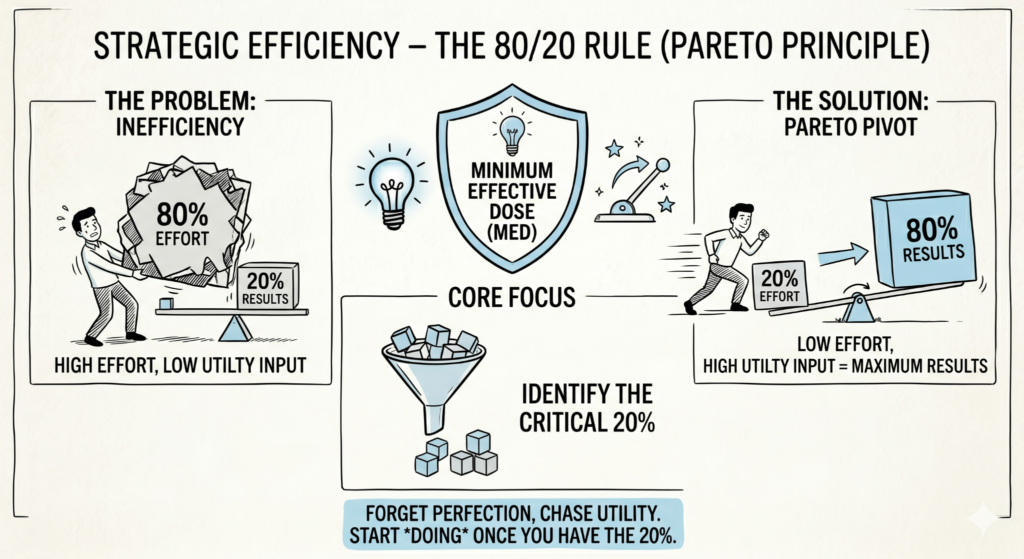
We’ve reached the final gear. If Phase 2 was about depth and Phase 4 was about retention, Phase 5 is about velocity.
Most people waste 80% of their time studying things that only contribute to 20% of their actual performance. A senior learner knows how to flip that script. We use the Pareto Principle: the idea that 80% of the results in any endeavor come from just 20% of the effort or input.
Phase 5 is about identifying the “Minimum Effective Dose” so you can reach competency while others are still reading the introduction.
1. Deconstruction: Breaking the “Big Skill”
Before you start, you must realize that every “skill” is actually a bundle of smaller “sub-skills.” For example, you don’t “learn to cook”; you learn to chop, to sauté, to season, and to manage heat.
How to Deconstruct:
- List every single component of the skill.
- Ask: What are the core building blocks that appear most frequently?
2. Selection: The 20% Filter
Once you have your list, you apply the 80/20 filter. You are looking for the tools or concepts that provide the most utility in the shortest amount of time.
Examples of the 20% Rule in Action:
- Language Learning: You don’t need 10,000 words. The top 1,000 most common words make up roughly 80% of everyday conversation.
- Coding: You don’t need every library. Master variables, loops, and logic first – they appear in almost every program.
- Guitar: You don’t need every scale. Learning 4 basic chords (G, C, D, Em) allows you to play thousands of popular songs.
| High-Impact (The 20%) | Low-Impact (The 80%) |
| Core Fundamentals | Niche, edge-case theories |
| Commonly used vocabulary | Advanced technical jargon |
| Practical application/Projects | Purely theoretical reading |
| High-frequency patterns | Rare exceptions and “fluff” |
3. The “Minimum Effective Dose” (MED)
In medicine, the MED is the smallest dose that will produce the desired outcome. Anything more is wasteful. In learning, the MED is the point where you have enough knowledge to actually start doing the thing.
Stop “preparing” to learn. Once you have the 20%, stop reading and start doing. The fastest learning happens when you encounter a problem while applying the 20% and have to go hunt for the solution.
The biggest obstacle to fast learning is the desire for perfection. Beginners want to learn everything in order. Experts learn the most important thing first, then ‘fill in the gaps’ through experience. Be okay with being ‘selectively ignorant’ of the fluff.
Phase 5 Checklist:
- Deconstruct: Have I listed all the sub-skills involved in this topic?
- Select: Have I identified the top 3-5 sub-skills that will give me 80% of the results?
- Execute: Am I spending more time practicing the “core” than reading about the “details”?
Conclusion: The Feedback Loop
You now have the complete Mastery Blueprint:
- Prime the engine (Phase 1).
- Simplify for deep understanding (Phase 2).
- Chunk for mental management (Phase 3).
- Recall for permanent memory (Phase 4).
- Focus on the 20% that matters (Phase 5).
Learning isn’t a gift; it’s a process. By following these phases, you aren’t just working harder – you are operating a more efficient machine. Now, take one thing you’ve been putting off and apply the “Pre-Game” scan right now.
The world belongs to those who can learn, unlearn, and relearn at speed. Go get started.
Leave a Reply